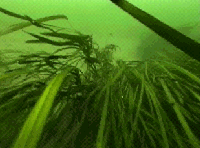
Eelgrass once thrived in clear, sunlit coastal waters. Fish were plentiful and diverse.

Now, most of the eelgrass is gone, the waters are turbid, and fish have declined.
|
Eelgrass once thrived in clear, sunlit coastal waters. Fish were plentiful and diverse. |
Now, most of the eelgrass is gone, the waters are turbid, and fish have declined. |
We are scientists concerned with the profound changes that have occurred in southern New England coastal waters over the last 50 years, including increased algal blooms, declines in eelgrass, fish and shellfish, and the low oxygen conditions in many estuaries. Underlying these alterations to coastal ecosystems is the changing pattern and intensity of land use in the coastal zone. The lure of living near the sea has proven irresistibly attractive. Human population in the coastal zone has increased dramatically in just a few decades, transforming rural and forested landscapes into suburban centers of commerce, industry, housing, and recreation. With these changes has come an ever-increasing load of nitrogen from the land to the estuary. Excess nitrogen is the single most important cause of the degradation observed in estuarine habitats and biotic communities. In the Background section of this presentation you will learn how the estuarine ecosystem is linked to land use by way of the nitrogen cycle. In the Model section you will be introduced to a mathematical model of these interactions that you can use to explore scenarios of land use and their effects on the estuarine ecosystem, specific to your local case. By clicking on highlighted terms you will find more detailed information, and you can navigate around the web site by clicking on the sections at the bottom of each page. We hope you find our presentation interesting and informative, and that the model helps to guide your planning decisions on land use in the coastal zone.