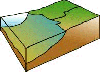
 The pristine watershed and estuary, 1700s
A trip through time in a coastal watershed
Southern New England coastal watersheds have undergone important changes over the past century, culminating in the intensive suburbanization of the last 50 years as an ever-increasing human population moved to and developed coastal lands. We can illustrate changing land use and its effects on the adjacent estuarine ecosystem through a series of images depicting the passage of time from a pristine, largely undeveloped watershed of the 1700s, to the era of intense farming of the 1800s, and on toward the fully suburbanized watershed typical of today’s conditions. These images in fact represent our conceptual model of land use and its effects on the estuary. Note the changes occurring in the aquatic system as you move forward in time. You can explore each image by clicking on highlighted terms to get more information.
The pristine watershed and estuary, 1700s
The
vegetated landscape absorbs natural atmospheric nitrogen deposition, and concentration of nitrate in groundwater is generally low. Natural marine nitrogen sources contribute significantly to the nitrogen balance in the estuary. Eelgrass is abundant and exists as a near-continuous band along the coast in water 1–3 m deep. Fish communities flourish.Farms (including cranberry bogs) introduce two major changes to the land-estuary connection. The first is the extensive felling of forests and conversion to pasture and crop land. The absorbing power of the naturally vegetated landscape is diminished, and more atmospheric nitrogen leaches from the soil and can reach the estuary. But, the atmospheric nitrogen load is still rather low since fossil fuel use is not yet a major contributor. The second major change introduced by farming is the widespread application of fertilizers. However, much fertilizer use is recycled farm production (manure) and so the net contribution of this nitrogen source is still small. Minor effects on eelgrass habitat might have been experienced locally.
The coming of suburbia, early-mid 1990s
With the advent of extensive
housing development near the coast, a major new source of nitrogen to the groundwater and estuary arrives – human waste. Waste disposal is haphazard and initially unregulated. Cesspools are a common on-site waste disposal system. Farming diminishes as a major component of the economy, and reforestation of farmlands helps ameliorate the impact of human waste nitrogen by retaining more atmospheric deposition. Eelgrass, however, is beginning to decline in many embayments by the 1960s.**Eelgrass was nearly wiped out on the eastern seaboard in the 1930s by a slime mold infestation, the cause of which is still debated. By the 1950s, eelgrass had returned to many embayments and was making a good recovery from the devastation of just a few years previous.
The fully-suburbanized watershed, late 20th Century and beyond
Human population surges into coastal regions from the 1960s on. Initially, little restrictions are placed on the rate of land development, as demand for land and profits soar.
Houses are packed as tightly as possible on coastal lands to take advantage of the insatiable quest for an ocean view. Shopping centers, malls, and expanded roadway and runway systems are built to accommodate the population crush, replacing the vegetated landscape with hard, impervious surfaces that shed nitrogen-laden runoff into storm drains and then into groundwater. Golf courses replace forest with turf, and along with the explosive growth of manicured lawns contribute industrially-derived fertilizer nitrogen. On-site septic systems proliferate with the burgeoning housing, and eventually are required to be septic systems with leaching fields. Although an improvement over cesspools and unregulated waste disposal, the sheer number and high density of such systems results in a huge increase in nitrogen traveling in groundwater to the estuary. The effects on the estuary are profound – increased algal blooms, replacement of eelgrass by macroalgae, increased susceptibility to low dissolved oxygen events, and loss of abundance and diversity in fish communities.